Cincinnati sits on a complex sequence of glacial till, interbedded shales and limestones from the Ordovician period, and extensive alluvial deposits along the Ohio River valley. The depth to bedrock can vary dramatically within a single block, from exposed outcrops in Clifton to over 100 feet of soil and weathered rock in the Mill Creek Valley. For structures requiring Improvement in these conditions, a well-calibrated grouting design is essential to control water flow, increase bearing capacity, or fill voids in karstic limestone. We combine local geological knowledge with pressure and volume monitoring to tailor each injection program to the specific site stratigraphy. Before finalizing the grout mix design, we often recommend a georradar survey to map shallow cavities and a resistivity test to delineate permeable zones in the bedrock.
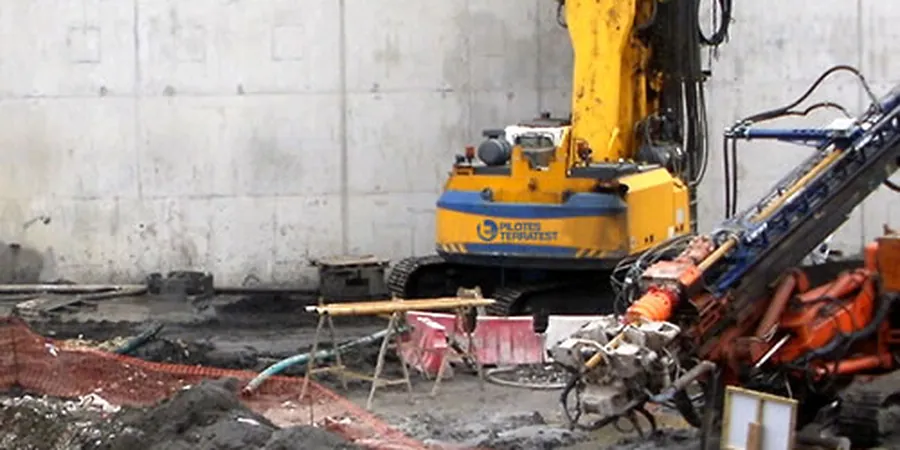
Grouting in Cincinnati's karstic limestone demands careful void mapping and real-time pressure control to avoid unintended hydrofracture or grout loss into the river.
Technical details of the service in Cincinnati
Critical ground factors in Cincinnati
Cincinnati's continental climate delivers about 42 inches of rainfall per year, with intense spring thunderstorms that can saturate the ground rapidly. When combined with the region's variable geology, the main risk in any grouting design is uncontrolled grout travel through open fissures or permeable strata, leading to waste of material and potential damage to adjacent utilities. The presence of the Ohio River alluvial aquifer means that groundwater flow can carry unset grout away from the intended treatment zone. We mitigate this by using set-control additives, stage injection with packers, and real-time pressure and flow monitoring. A secondary risk is heave of shallow foundations if injection pressures are not carefully limited near existing structures. Our team follows the ASCE Grouting Committee guidelines and ASTM D5092 for monitoring well installation to ensure every project is executed safely and reliably in Cincinnati.
This service complements our laboratory testing work for a complete project analysis.
Our services
We offer four specialized grouting design services tailored to the subsurface conditions commonly encountered in Cincinnati.
Permeation Grouting
Low-pressure injection of cementitious or chemical grouts into granular soils to fill pore spaces and increase strength without disturbing the soil structure. Ideal for alluvial sands under existing structures.
Compaction Grouting
High-viscosity, low-slump grout injected as a bulbous mass that displaces and densifies loose soils or fills. Used for settlement mitigation under slabs and shallow footings on legacy fill.
Fracture Grouting
Intermediate-pressure injection that creates grout lenses in stratified soils, improving stiffness and reducing permeability. Applied in interbedded clay-shale sequences typical of the Cincinnati area.
Karst Void Filling
Targeted injection of high-volume, low-strength grout into solution cavities in limestone bedrock. Designed to prevent sinkhole formation and provide a stable platform for foundations.
Common questions
What is the typical cost range for a grouting design project in Cincinnati?
For a standard residential or commercial project in Cincinnati, the cost for grouting design and supervision typically ranges from US$1.250 to US$3.720. This includes site investigation, mix design, pressure monitoring, and verification testing. Larger volume or more complex karst sites may fall above this range.
How do you determine the correct grout mix for Cincinnati's soil conditions?
We start with borehole logs and water pressure tests to estimate permeability and fracture aperture. For alluvial sands, a cementitious mix with a water-cement ratio of 0.6:1 is typical. For clayey fills, we often use compaction grout with a low slump. The mix is always verified with trial batches and unconfined compression tests before full-scale injection.
Can grouting be used to fix settlement in old Cincinnati houses on hillside fill?
Yes, compaction grouting is often the most cost-effective solution for stabilizing loose fill beneath existing foundations. We inject stiff grout bulbs in stages to densify the soil without causing heave. A careful pre- and post-injection survey with settlement monitoring is part of the design.
What is the difference between permeation and compaction grouting?
Permeation grouting fills the pores of granular soils without displacing the soil skeleton, using low-viscosity grouts at low pressure. Compaction grouting uses a stiff, low-slump grout that pushes the soil aside, densifying it. The choice depends on soil type: permeation for clean sands and gravels, compaction for loose fills or silty soils.
How does the karst geology of Cincinnati affect grouting design?
The limestone bedrock under parts of Cincinnati contains solution cavities and fissures that can cause sudden grout loss. We design with higher yield volumes, set accelerators, and stage injection with packers to seal off large voids first. A pre-grout geophysical survey is recommended for any site near known sinkhole areas.