When our team deploys a drilling rig on a Cincinnati hillside, the first step is always a detailed site reconnaissance. The Ohio River valley creates a unique geology here — interbedded shales, limestones, and glacial till deposits from the Wisconsinan glaciation. We core into the Kope Formation and Fairview Formation, measuring RQD and fracture spacing. This data feeds directly into our slope stabilization design, whether we are working on a cut slope for a new subdivision in Mount Auburn or a retaining wall along Columbia Parkway. Before any design begins, we run laboratory tests on undisturbed samples to determine shear strength parameters. A compression simple test gives us quick undrained strength, while consolidated drained triaxial tests define effective stress parameters for long-term stability.
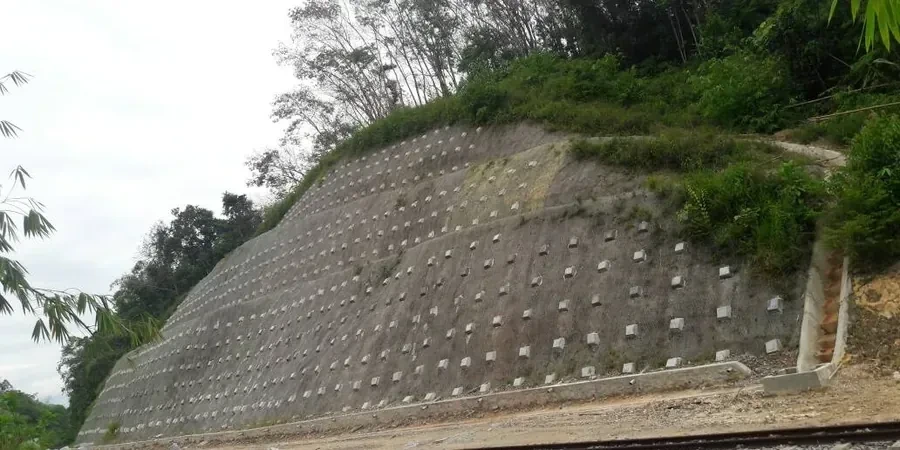
Cincinnati's interbedded shale and limestone sequence requires site-specific shear strength parameters, not generic textbook values, for reliable slope stabilization design.
Technical details of the service in Cincinnati
Critical ground factors in Cincinnati
In Cincinnati, many older retaining walls and slopes were built with no formal geotechnical analysis. We often see walls leaning 5 to 10 degrees out of plumb, with tension cracks running parallel to the crest. The risk is not just collapse — it is progressive failure. Once a crack opens, water infiltrates, pore pressures rise, and the factor of safety drops below 1.0 during a heavy storm. We have documented cases where a 24-hour rainfall of 3 inches triggered a 500-cubic-yard landslide in the Mount Lookout neighborhood. A proper slope stabilization design identifies these failure mechanisms early and prescribes drainage, soil nailing, or tieback anchors before movement starts.
This service complements our laboratory testing work for a complete project analysis.
Our services
Our slope stabilization design service covers the full spectrum from investigation through construction monitoring. We tailor each solution to Cincinnati's specific geology and urban constraints.
Geotechnical Investigation for Slopes
We drill borings, install piezometers, and sample undisturbed Shelby tubes. Laboratory testing includes direct shear, triaxial, and index properties. The data supports limit equilibrium and finite element modeling for both static and pseudo-static conditions.
Stabilization Design & Construction Support
We design soil nail walls, anchored systems, rock bolts, and drainage blankets. Our team reviews contractor submittals, observes field installation, and verifies nail pull-out tests per FHWA guidelines. We also perform as-built slope mapping.
Common questions
What factors influence slope stabilization design cost in Cincinnati?
The cost typically ranges from US$1,780 to US$5,680 for a standard residential or small commercial site. This depends on slope height, access difficulty, number of borings, and laboratory testing scope. Complex urban sites near existing structures or requiring deep anchors can exceed this range.
What is the minimum factor of safety required for slopes in Cincinnati?
For permanent slopes under static conditions, we follow FHWA guidance requiring a minimum factor of safety of 1.5. Under seismic loading (Seismic Design Category C), the minimum drops to 1.1 per IBC 2021. Temporary construction slopes may use 1.3.
How deep should borings be for a slope stability study?
Borings must extend at least 1.5 times the slope height below the toe or to a depth where bedrock is confirmed, whichever is greater. In Cincinnati's Kope Formation, we typically reach refusal at 20 to 40 feet. We also install piezometers at multiple depths to monitor groundwater.
Do I need a seismic analysis for my slope in Cincinnati?
Yes, if the slope is taller than 15 feet and the site is in Seismic Design Category C or higher. Most of Cincinnati falls under SDC C. We perform pseudo-static analysis using ASCE 7-22 ground motion parameters and, for critical slopes, a Newmark sliding block displacement analysis.
What drainage measures are typical for Cincinnati slopes?
We specify horizontal drains, French drains, and surface water diversion channels. Horizontal drains are drilled at 5- to 10-foot vertical intervals and extend 50 to 100 feet into the slope. Outlets must be protected from freeze-thaw damage typical of Cincinnati winters.