In Cincinnati, many times we see cut slopes on the steep hillsides overlooking the Ohio River that were designed decades ago without a proper stability check. The glacial till and interbedded shale layers here create a tricky profile — low cohesion in the upper soils combined with perched water tables after heavy rain. Our team runs a full limit-equilibrium analysis using Spencer and Bishop methods to compute factor of safety under both static and seismic conditions. We couple that with field data from boreholes to define the critical slip surface. For deeper failures, we often recommend a resistivity survey to map the bedrock interface and any groundwater seepage paths before modeling.
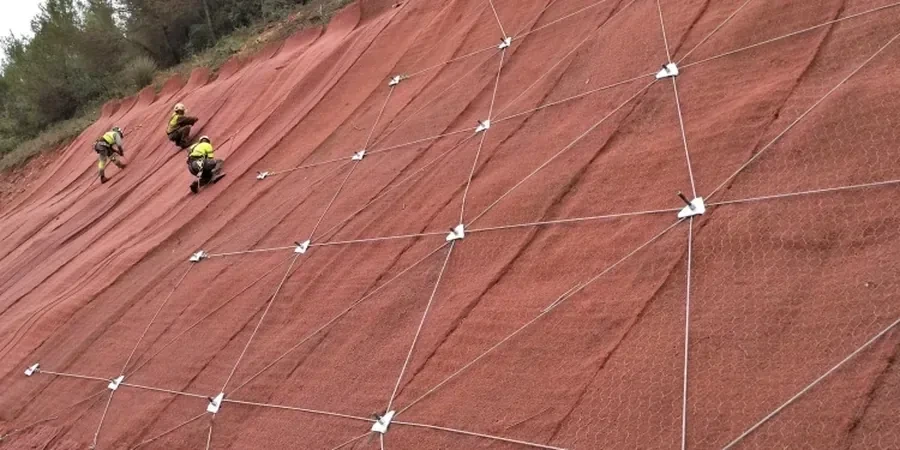
A single groundwater reading from a standpipe can shift the factor of safety by 0.3 — never assume pore pressure in Cincinnati's shale slopes.
Technical details of the service in Cincinnati
Procedure video
Critical ground factors in Cincinnati
Cincinnati's urban expansion pushed development onto hillsides that were originally considered unbuildable. During the 1950s and 1960s, many subdivisions in Price Hill and Fairview were carved into slopes with little to no geotechnical oversight. Today, those same slopes show signs of distress: cracked retaining walls, tilted fence lines, and pavement offsets. The risk isn't just new construction — existing homes on marginal slopes face progressive creep that accelerates during wet winters. A proper stability analysis identifies whether the failure is shallow (raveling of colluvium) or deep-seated (movement along shale bedding). We flag any slope with a safety factor below 1.3 as requiring intervention, especially if it supports a structure or roadway.
This service complements our laboratory testing work for a complete project analysis.
Our services
We offer two primary approaches to slope stability analysis in Cincinnati, each tailored to the site's geometry and failure mechanism.
Limit-Equilibrium Analysis (2D)
Bishop simplified and Spencer methods for circular and non-circular slip surfaces. Includes Monte Carlo sensitivity on cohesion and friction angle. Suitable for most residential and commercial slopes up to 50 ft high.
Finite Element / Finite Difference Analysis
Plaxis 2D or FLAC modeling for complex geometries — irregular slope shapes, multi-layer stratigraphy, or slopes with existing retaining structures. Captures stress redistribution and progressive failure.
Common questions
What factor of safety is required for a slope in Cincinnati under the IBC?
IBC 2021 requires a minimum factor of safety of 1.5 under static conditions and 1.1 under seismic loading. For slopes that support critical infrastructure or are adjacent to occupied buildings, we typically recommend 1.5 for seismic as well. These values assume drained conditions based on effective stress parameters.
How much does a slope stability study cost in Cincinnati?
The typical cost for a slope stability analysis in Cincinnati ranges between US$1.370 and US$4.710, depending on slope height, number of boreholes required, and whether laboratory shear testing is included. A basic desktop study with existing data is at the lower end; a full field investigation with triaxial testing and numerical modeling is at the upper end.
What is the difference between Bishop and Spencer methods in slope stability?
Bishop's simplified method assumes circular slip surfaces and satisfies moment equilibrium but ignores interslice shear forces. Spencer's method is more rigorous — it satisfies both moment and force equilibrium and can handle non-circular slip surfaces along weak bedding planes or existing cracks. For Cincinnati's shale slopes where failure often follows bedding, Spencer is the preferred method.