A seven-story apartment complex near Eden Park showed 4 inches of differential settlement within six months of completion. The underlying soft clay layers had not been characterized before foundation design. In Cincinnati, the Ohio River valley deposits create a challenging profile for bearing capacity. Settlement analysis in Cincinnati must account for the thick sequences of alluvial soils that underlie much of the downtown area and neighborhoods along the river. Before designing shallow foundations on these sediments, engineers require consolidation test data and one-dimensional compression curves. The key is to predict both total and differential settlement under working loads. We combine oedometer tests with capacidad de carga evaluations to set safe bearing pressures. Our reports reference the specific soil strata found at each site rather than relying on regional averages.
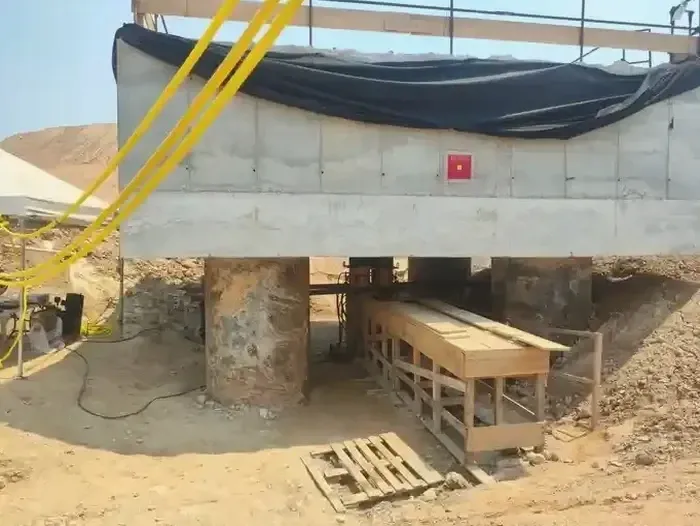
Differential settlement in Cincinnati's alluvial clays can exceed 3 inches if the compressibility profile is not mapped layer by layer.
Technical details of the service in Cincinnati
- Thin-walled tube sampling to obtain undisturbed specimens for consolidation testing per ASTM D2435
- One-dimensional consolidation curves to determine compression index (Cc) and preconsolidation pressure (σ'p)
- Time-rate analysis using coefficient of consolidation (Cv) for each clay layer
Procedure video
Critical ground factors in Cincinnati
The glacial lake clays underlying Cincinnati can be lightly overconsolidated near the surface but become normally consolidated below 30 feet. That shift causes a sudden increase in compressibility. Combined with the high water table in the floodplain areas — often within 8 feet of the surface — the risk of long-term consolidation settlement is real. A project in the West End experienced 2.5 inches of settlement over three years because the intermediate clay layer was not tested. Our settlement analysis in Cincinnati identifies these transitional zones by running incremental loading tests on specimens from each distinct stratum. We also incorporate the effect of adjacent excavations using excavaciones-profundas data when applicable.
This service complements our laboratory testing work for a complete project analysis.
Our services
Our settlement analysis service covers field investigation, laboratory testing, and numerical modeling. We provide two primary service lines tailored to the site conditions in Cincinnati.
Consolidation Testing Program
Thin-walled Shelby tube sampling followed by incremental loading consolidation tests per ASTM D2435. We determine Cc, Cr, σ'p, and Cv for each clay layer. Results include time-settlement curves and recommendations for foundation type.
Settlement Modeling & Reporting
One-dimensional and two-dimensional settlement analyses using site-specific parameters. We calculate total and differential settlement for spread footings, mats, and pile groups. Reports include contour maps of predicted settlement and construction recommendations.
Common questions
How much does a settlement analysis cost in Cincinnati?
The typical cost for a settlement analysis ranges between US$560 and US$1,450. This covers field sampling, consolidation testing on up to six specimens, and a calculation report. Larger projects with multiple boring locations may fall at the higher end.
What is the difference between consolidation and settlement?
Consolidation is the time-dependent volume change in saturated clay due to water being expelled from the pores. Settlement is the vertical downward movement of the foundation that results from that volume change. Settlement analysis uses consolidation test data to predict how much and how fast the ground will move under load.
Do I need settlement analysis for a single-family house in Cincinnati?
It depends on the soil conditions. If the house is built on the glacial till found in hilltop areas, settlement is usually minimal. But if the site is in the Mill Creek Valley or near the Ohio River, where soft alluvial clays exist, a basic consolidation test is recommended to avoid long-term differential settlement that can crack foundations.
How long does it take to complete a settlement analysis?
The consolidation test itself takes 7 to 14 days because each load increment must sit until primary consolidation is complete. The full analysis, including sampling, testing, and report writing, typically takes three to four weeks from the date of field work.