Soils along the Ohio River floodplain in Cincinnati behave very differently from the stiff glacial tills found in the northern suburbs like Mason. While the till deposits offer immediate bearing capacity, the soft alluvial clays and silts near the river require careful preloading design without surcharge to achieve long-term stability. For a warehouse project in the West End, we applied a staged fill program over 14 weeks, monitoring pore pressure dissipation with piezometers to ensure the target settlement was reached before slab construction. Combining this approach with a plate load test on the final surface gave the owner confidence that differential movements would stay within 25 mm over the building's life.
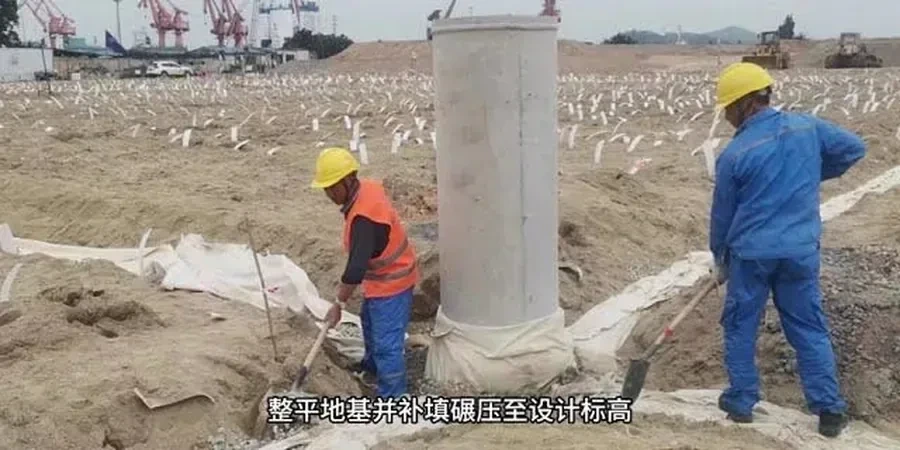
Primary consolidation in Cincinnati's alluvial clays can take 6 to 18 months without drains; preloading design without surcharge cuts that to 10-14 weeks with staged fills.
Technical details of the service in Cincinnati
- Borrow fill placement in 0.5 m lifts with density control
- Piezometer and settlement plate installation at critical depths
- Asaoka method projection for time to 90% consolidation
- Load removal criteria based on residual settlement < 20 mm/year
Critical ground factors in Cincinnati
In Cincinnati, many times we see that contractors underestimate the time required for consolidation in the downtown basin clays. A common mistake is removing the fill too early, thinking the settlement plates have stabilized, when in fact secondary compression is still active at a rate of 5–8 mm per month. This can lead to slab curling and floor cracking within the first year of operation. Our preloading design without surcharge includes a hold period with pore pressure monitoring to confirm that the effective stress gain is permanent, not just a temporary response to the fill load.
This service complements our laboratory testing work for a complete project analysis.
Our services
We deliver three complementary services to support preloading design without surcharge in Cincinnati:
Consolidation Testing & Analysis
One-dimensional oedometer tests per ASTM D2435 on undisturbed samples from each major clay stratum. We provide Cc, Cr, cv, and preconsolidation stress values needed for settlement prediction.
Field Monitoring & Instrumentation
Installation of settlement plates, pneumatic piezometers, and inclinometers. Weekly data collection with remote telemetry available for critical projects, ensuring real-time control of fill placement rates.
Settlement Verification & Load Removal Criteria
Asaoka and hyperbolic curve-fitting methods to project ultimate settlement. We issue a clearance report when residual settlement drops below 20 mm/year, allowing slab construction to proceed safely.
Common questions
How long does preloading without surcharge typically take in Cincinnati clays?
For a 5 m thick clay layer with cv around 4 m²/year, expect 10 to 14 weeks of staged fill placement followed by 4 to 6 weeks of monitoring. This assumes no vertical drains are used. With drains, the consolidation period shortens to 6 to 8 weeks.
What is the typical cost range for a preloading design without surcharge study in Cincinnati?
A full design and monitoring package for a medium-sized site (1-2 acres) ranges from US$810 to US$1,950, depending on the number of test borings, instrumentation points, and monitoring duration. This includes oedometer tests, settlement analysis, and the final clearance report.
Can preloading design without surcharge handle deep clay layers in the Ohio River floodplain?
Yes, but for clay layers exceeding 6 m, we recommend combining preloading with vertical wick drains to accelerate drainage. Without drains, the time to 90% consolidation can exceed 18 months, which is rarely feasible for construction schedules. Our design accounts for both scenarios.