Cincinnati grew along the Ohio River valley, where thick deposits of glacial outwash and lacustrine clays dominate the subsurface. These soft, compressible soils have challenged builders since the 19th century. We perform the oedometer consolidation test to measure how much the ground will settle under load. Knowing the consolidation characteristics early avoids differential settlement in new structures. Before designing deep foundations, we often recommend a georradar-gpr survey to map buried utilities and voids, and a advanced direct shear test to complement the oedometer data with shear strength parameters.
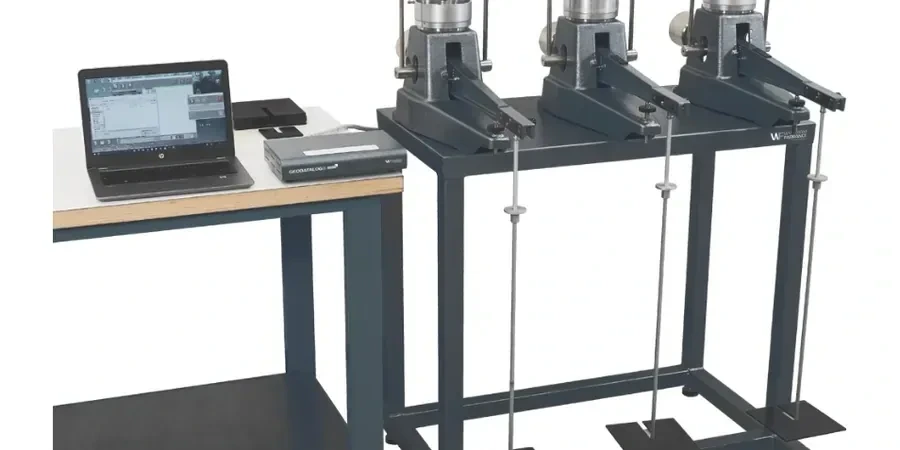
We have seen clay layers in downtown Cincinnati with OCR below 1.5, meaning the ground is still settling from its own weight.
Technical details of the service in Cincinnati
- Load stages: 12.5, 25, 50, 100, 200, 400, 800, 1600 kPa
- Unload-reload cycles for overconsolidation ratio (OCR)
- Results in 7–10 business days
Critical ground factors in Cincinnati
Cincinnati lies in a moderate seismic zone (ASCE 7 Site Class C or D). Soft alluvial clays amplify ground motion and can undergo large post-construction settlement under cyclic loading. The Ohio River valley also has buried channels filled with loose sands and soft clays. If the oedometer consolidation test shows a high compression index and low preconsolidation pressure, the risk of differential settlement between columns is significant. We have documented cases where ignoring these parameters led to floor slab cracks exceeding 25 mm in new warehouses near the riverfront.
This service complements our laboratory testing work for a complete project analysis.
Our services
We offer three levels of oedometer consolidation testing tailored to Cincinnati's clay conditions.
Standard Incremental Loading Oedometer
Up to 8 load stages with unload-reload loop. Reports Cc, Cr, σ'p, cv, and settlement estimate. Ideal for low-rise commercial buildings on spread footings.
Extended Oedometer with Creep Analysis
Adds long-term secondary compression monitoring (Cα). Used for warehouses, storage tanks, and bridge approaches where sustained loads cause creep settlement over decades.
Constant Rate of Strain (CRS) Oedometer
Faster than incremental loading. Continuous pore pressure measurement allows determination of cv at every strain level. Suitable for deep clay deposits beneath highway embankments.
Common questions
What does the oedometer consolidation test measure?
It measures how much a saturated clay layer compresses over time under a vertical load. Key outputs include the compression index (Cc), preconsolidation pressure (σ'p), and coefficient of consolidation (cv). These values are used to predict settlement magnitude and rate for foundation design.
How long does the test take in your Cincinnati lab?
A standard incremental test with 8 load stages and one unload-reload cycle is completed in 7 to 10 business days. If you need results faster, we offer the constant rate of strain (CRS) method, which can finish in 2 to 3 days.
How much does an oedometer consolidation test cost in Cincinnati?
The typical cost ranges from US$180 to US$390 per sample, depending on the number of load stages and whether creep analysis is included. Volume discounts apply for projects requiring multiple tests across different boring depths.