Our rigs set up on Ohio River terraces and downtown fill zones. The rotary drill uses a 4-inch split-spoon sampler for SPT at 5-foot intervals per ASTM D1586-18. We log each blow count, measure groundwater, and recover intact samples. For raft foundations in Cincinnati, the key is mapping the stiffness contrast between Pleistocene glacial tills and Holocene alluvium. We start every project with a resistivity survey SEV to detect buried channels or voids before any load calculation. The data feeds directly into modulus of subgrade reaction (k-value) for mat sizing.
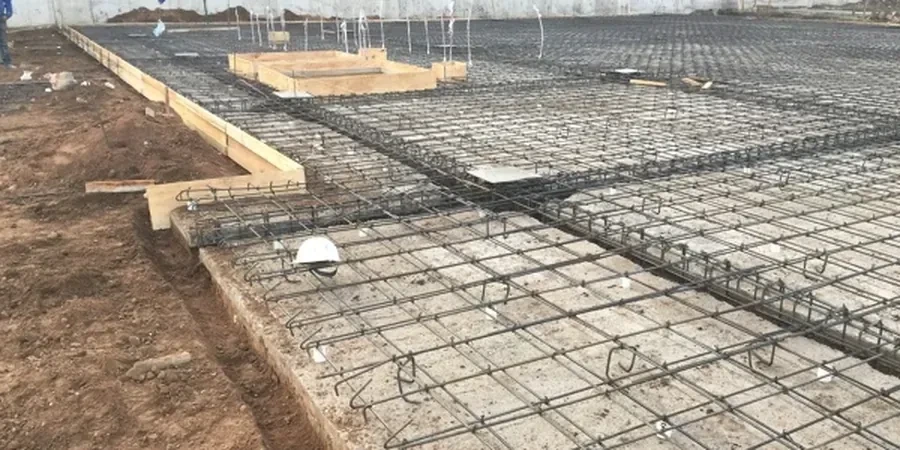
Raft foundations in Cincinnati demand 3D stiffness profiling: glacial till stiffness varies by over 200% within one city block, and mat design must absorb that.
Technical details of the service in Cincinnati
Critical ground factors in Cincinnati
IBC 2021 section 1803 mandates a geotechnical investigation for any raft foundation in Cincinnati. The city sits in a moderate seismic zone (ASCE 7 Site Class C/D) with mapped spectral acceleration Ss ~0.25g. Liquefaction potential in loose sands near Mill Creek and the Ohio River requires cyclic resistance ratio (CRR) curves from SPT data. Without a full subsurface program, the risk of punching shear failure or excessive long-term settlement increases sharply. Our reports include explicit settlement contours and a factor of safety against bearing failure, signed by a licensed PE in Ohio.
This service complements our laboratory testing work for a complete project analysis.
Our services
Our raft foundation design service includes the following technical components, each tailored to Cincinnati’s subsurface conditions:
Subsurface Investigation & SPT Program
Boreholes to 60 ft depth with continuous SPT sampling. Lab tests for Atterberg limits, natural moisture content, and unconfined compression. We map soil layers for mat bearing zone.
Mat Foundation Structural Modeling
Finite-element analysis using SAFE or SAP2000. Slab thickness, reinforcement layout, and settlement checks. We integrate subgrade reaction (k) from plate load tests.
Seismic Site Response & Liquefaction Screening
Cyclic stress ratio calculations per Youd-Idriss (2001). Site class determination per ASCE 7. We flag zones requiring Improvement before raft placement.
Construction Quality Assurance (CQA)
Field density tests (ASTM D1556), proof-rolling, and verification of subgrade moisture. We issue a final report with as-built k-values and settlement monitoring plan.
Common questions
When is a raft foundation preferred over spread footings in Cincinnati?
Rafts are chosen when soil bearing capacity is low (under 3,000 psf) or when differential settlement from variable glacial till is a concern. They also work well for heavy structures like mid-rise buildings on fill or sloped sites.
What soil parameters are critical for mat foundation design?
The modulus of subgrade reaction (k) and allowable net bearing capacity are primary. We also need the soil's cohesion, friction angle, and consolidation properties from lab tests. SPT N-values provide a secondary check for consistency.
How much does a raft foundation geotechnical study cost in Cincinnati?
The typical range is between US$1.000 and US$3.620, depending on the number of borings, lab tests, and complexity of the site. This includes the field program, analysis, and a signed report.
Does Cincinnati's seismic risk affect raft foundation design?
Yes. ASCE 7 classifies most of the city as Site Class C or D, with mapped Ss near 0.25g. We must check liquefaction in loose sands and add reinforcement for potential lateral spreading. The raft’s rigidity helps distribute seismic loads.