On a recent project along the Mill Creek Valley, we encountered a buried channel filled with loose sands and soft clays extending to 18 m depth. The original foundation design for a 10-story structure called for deep piles, but the presence of cobbles and boulders made driving difficult. We proposed a jet grouting design to create a block of treated soil beneath the spread footings, reducing settlements to under 25 mm. The treatment diameter in the granular layers reached 1.8 m, while in the clay-rich zones it dropped to 1.2 m. Before finalizing the design, we ran a georradar survey to map the buried valley geometry and locate the coarser lenses. That data allowed us to adjust the grouting parameters for each lift, ensuring uniform strength across the treatment zone.
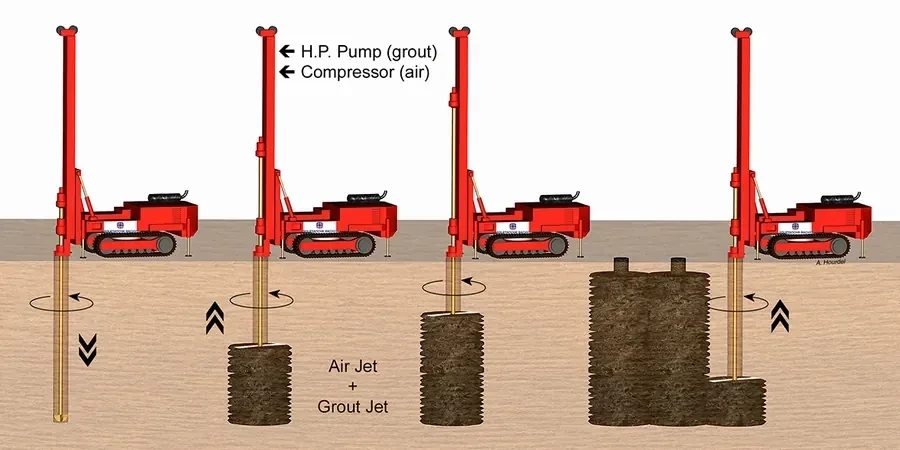
In the Mill Creek buried valley, we reduced predicted settlements from 60 mm to under 25 mm using a jet grouted block beneath the existing footings.
Technical details of the service in Cincinnati
Procedure video
Critical ground factors in Cincinnati
The most common mistake we see in Cincinnati is assuming a uniform treatment diameter across the site. Contractors often use a single set of jet grouting parameters for the entire project, ignoring the clay lenses and sand pockets that alternate unpredictably in the glacial till. The result is under-treated zones with strengths below 1 MPa, leading to differential settlements that crack the structure. On a recent highway bridge abutment, we had to re-treat 12 columns because the initial design did not account for a 2 m-thick clay seam at 8 m depth. A proper jet grouting design must incorporate site-specific stratigraphy, not generic values from the literature.
This service complements our laboratory testing work for a complete project analysis.
Our services
We offer a complete suite of jet grouting design services tailored to Cincinnati's subsurface conditions, from concept through field verification.
Geotechnical Investigation & Parameter Selection
Boreholes with SPT, undisturbed sampling, and laboratory triaxial tests to determine erodibility, cohesion, and friction angle for jet grouting design.
Treatment Geometry & Column Layout
Calculation of column diameter, spacing, and overlap based on soil type, depth, and target strength, using 3D models for complex buried valley conditions.
Grout Mix Design & Field Trials
Formulation of water-cement-bentonite mixtures with controlled rheology, followed by test columns with excavation and core sampling to verify diameter and strength.
Production Monitoring & Quality Control
Real-time recording of flow rate, pressure, rod rotation, and withdrawal speed; weekly unconfined compression tests on in-situ cores to confirm design compliance.
Common questions
What is the typical treatment diameter for jet grouting in Cincinnati's glacial soils?
In granular outwash deposits common along the Ohio River, diameters range from 1.5 to 2.2 m. In the stiff glacial till or clay lenses, diameters drop to 0.8–1.4 m. The actual value depends on the specific energy applied and the soil erodibility index determined from site-specific borings.
How much does a jet grouting design study cost for a typical building project in Cincinnati?
For a mid-size project with 6–10 borings, laboratory testing, and a design report, the cost ranges from US$1,510 to US$6,650. The final price depends on the number of test columns, the need for 3D modeling of buried valleys, and the level of quality control required.
Does jet grouting work in the stiff glacial till found in Cincinnati's hillsides?
Yes, but the treatment diameter is smaller (typically 0.8–1.1 m) due to the high plasticity and low erodibility of the till. We compensate by reducing the rod withdrawal rate and increasing the grout pressure to 35–40 MPa. Pre-drilling with a rock bit may be needed if boulders are present.
What quality control tests are performed after jet grouting?
We excavate test columns to measure actual diameter and continuity, take core samples for unconfined compressive strength (target 2–8 MPa at 28 days), and conduct falling-head permeability tests (target below 1×10⁻⁶ cm/s). For critical structures, we also perform cross-hole sonic logging to verify integrity.
How does jet grouting compare to deep soil mixing for underpinning in Cincinnati?
Jet grouting is more effective in layered soils with cobbles and boulders because it uses a high-velocity jet to erode and mix the soil in situ. Deep soil mixing requires auger penetration, which can be obstructed by the large cobbles common in Ohio River terrace deposits. Jet grouting also achieves lower permeability, which is advantageous in dewatering applications.