Cincinnati sits on the Ohio River floodplain where soft alluvial clays and silts can reach depths of 15 meters or more. For any project involving embankments, approach fills, or building pads on these compressible soils, prefabricated vertical drain design becomes the most practical solution to accelerate consolidation. We have worked on several sites near the river where untreated ground would have taken years to reach acceptable settlement limits. By installing PVDs at the right spacing and depth, we cut that timeline to months. Before laying out the drain pattern we always cross-check with a plate load test to capture the actual modulus of the soft layer, and we use consolidation testing data to refine the coefficient of consolidation (cv) for each soil unit.
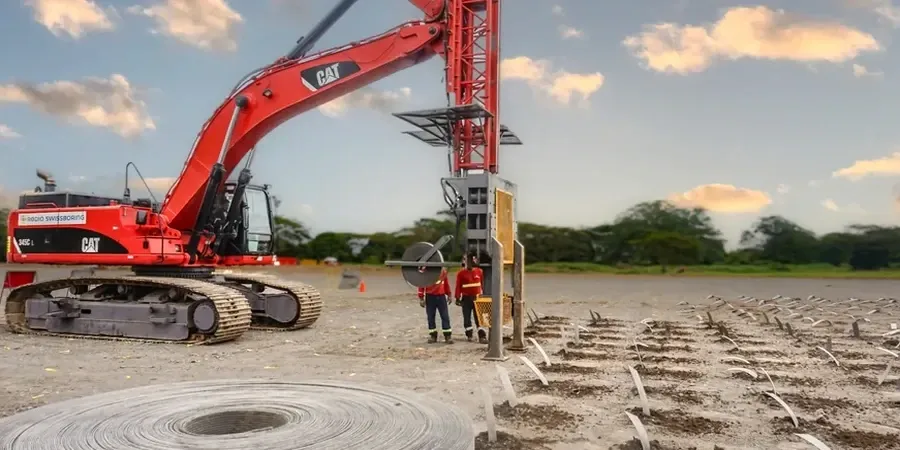
PVDs turn years of waiting into months of controlled settlement, but the design must match local clay behavior and drainage conditions.
Technical details of the service in Cincinnati
Critical ground factors in Cincinnati
The biggest risk in Cincinnati is underestimating the smear effect in soft lacustrine clays. When the mandrel pushes through, the remolded zone around each drain can reduce radial permeability by a factor of 3 to 5. If you ignore that, the predicted consolidation time will be optimistic by months. We follow Hansbo's radial consolidation theory and always adjust the well resistance factor for drains longer than 12 meters. For deep soft deposits near the Mill Creek Valley we also run a [MASW survey](/masw-vs30/) to map the thickness of the compressible layer before finalizing the drain depth. Another risk: clogging of the filter fabric by fine silt if the drain is left without immediate surcharge. We design the surcharge load to be applied within 7 days of drain installation.
This service complements our laboratory testing work for a complete project analysis.
Our services
Our geotechnical team provides a full suite of services to support PVD projects in Cincinnati:
Consolidation Analysis and PVD Layout
We run one-dimensional consolidation tests (ASTM D2435) on undisturbed tube samples to determine cv, cr, and cc. Using that data we model radial consolidation with smear and well resistance effects. The output is a drain spacing and depth schedule matched to the project's settlement criteria.
Field Monitoring and Verification
After installation we set up settlement plates, piezometers, and inclinometers to track pore pressure dissipation and surface heave. We compare real-time data against the design curve and adjust the surcharge schedule if needed. This step is critical for projects with tight post-construction settlement tolerances.
Common questions
How long does PVD design usually take for a Cincinnati project?
For a typical embankment or building pad site, the design phase takes 3 to 4 weeks. That includes field sampling, lab consolidation tests, radial consolidation modeling, and the drain layout plan. If pre-existing consolidation data is available, we can shorten that to 2 weeks.
What soil conditions in Cincinnati are best suited for PVDs?
PVDs work best in soft, saturated, compressible clays and silts with low permeability (k < 10⁻⁷ cm/s). In Cincinnati we see these conditions along the Ohio River floodplain and in the Mill Creek Valley. Sites with high organic content or peat layers need special filter design to prevent clogging.
How much does prefabricated vertical drain design cost in Cincinnati?
The design cost typically ranges between US$920 and US$2,410, depending on the number of soil units, the complexity of the drainage layer, and whether field monitoring is included. This covers sampling, lab testing, modeling, and a final design report.
Why is smear zone correction important in PVD design?
When the mandrel with the drain is pushed into the soil, it remolds a thin zone around the drain. That remolded zone has much lower radial permeability than the undisturbed soil. Ignoring the smear effect can overestimate the consolidation rate by 30 to 50%. We use the reduced permeability ratio (kh/ks) measured from laboratory tests to correct the design.