A common mistake we see among contractors and developers in Cincinnati is assuming that a single geocell specification works for the whole site. The city sits on a complex mix of glacial till, weathered shale, and alluvial deposits along the Ohio River valley, so a one-size-fits-all approach to geocell design can lead to differential settlement or premature failure of retaining structures. When we evaluate the actual subgrade conditions and loading requirements, the geocell design becomes a tailored solution that accounts for local soil behavior and groundwater fluctuations. Skipping this step often means expensive repairs later, especially on projects where the fill material or traffic loads were underestimated from the start.
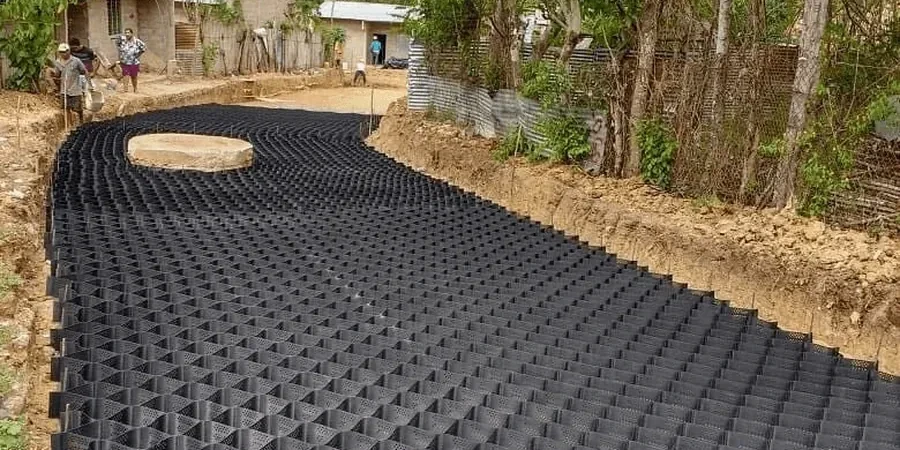
A one-size-fits-all geocell specification ignores Cincinnati's glacial till and alluvial soils, often leading to differential settlement and premature structural failure.
Technical details of the service in Cincinnati
Critical ground factors in Cincinnati
When the geocell installation crew unrolls the panels on a Cincinnati site, the first thing they check is the subgrade moisture content. If the underlying soil is saturated from the previous week's rain, placing the geocell directly on it without proper drainage can trap water inside the cells and accelerate degradation of both the polymer and the infill. We have seen this happen on several projects near the Mill Creek Valley, where the clay-rich soils hold moisture for days after a storm. A proper geocell design for this region must include a drainage assessment and, where needed, a perforated underdrain system to keep the base course dry.
This service complements our laboratory testing work for a complete project analysis.
Our services
We offer a complete range of geocell-related services, from initial site assessment through final design documentation. Each service is adapted to Cincinnati's specific geotechnical profile.
Geocell Foundation Design
Tailored cellular confinement layouts for unpaved roads, parking areas, and temporary construction platforms. We calculate cell depth, infill gradation, and connection details based on the site's CBR and traffic load spectrum.
Slope and Channel Stabilization
Geocell systems for erosion control on steep embankments and drainage channels. Our designs include anchor trench details, vegetation infill recommendations, and hydraulic analysis for Cincinnati's high-intensity rainfall events.
Retaining Wall Reinforcement
Geocell-reinforced soil walls for residential and commercial developments. We provide full stability checks, foundation bearing analysis, and construction phasing plans that account for the local frost depth and groundwater conditions.
Common questions
What is the typical cost for a geocell design in Cincinnati?
For most residential and small commercial projects in the area, the geocell design fee ranges between US$920 and US$2,150 depending on the site complexity, number of load cases, and whether drainage modeling is required. This includes the subgrade assessment, cell geometry calculations, and a construction-ready drawing set.
How deep do geocell panels need to be for a driveway in Cincinnati?
For standard residential driveways with light truck traffic, we typically specify a 100 mm (4 in) cell depth using a perforated or non-perforated geocell over a compacted subgrade with CBR ≥ 3. If the subgrade is softer, we increase the depth to 150 mm (6 in) and add a geotextile separator below.
Can geocells be used on slopes with Cincinnati's clay soils?
Yes, but the clay's low permeability requires careful drainage integration. We usually install a perforated pipe at the toe of the slope and specify a crushed stone infill with at least 30% void space to allow lateral drainage. The geocell itself provides confinement, but without drainage the pore pressures can build up and reduce stability.
What is the difference between a geocell and a geogrid for slope reinforcement?
A geogrid provides tensile reinforcement in a planar direction, while a geocell offers three-dimensional confinement of the infill material. For shallow slope failures or erosion control on steep faces, geocells are more effective because they prevent lateral spreading of the soil. Geogrids are better for deep-seated stability where the failure surface extends below the reinforced zone.