We recently supervised a road widening project on I-75 near downtown Cincinnati where the existing subgrade was a fat clay with a plasticity index over 40. The contractor had already placed two feet of granular fill, but within weeks differential settlement cracked the new pavement. We stepped in with a lime stabilization program that reduced the PI to below 20 and raised the CBR from 3 to 15 in just seven days. That fix saved the client over 200,000 dollars in replacement costs. Cincinnati's glacial till and alluvial deposits along the Ohio River create highly variable soil conditions, so a one-size-fits-all approach never works. We always run a classification of soils first to identify the dominant clay minerals, then design the stabilizer blend accordingly.
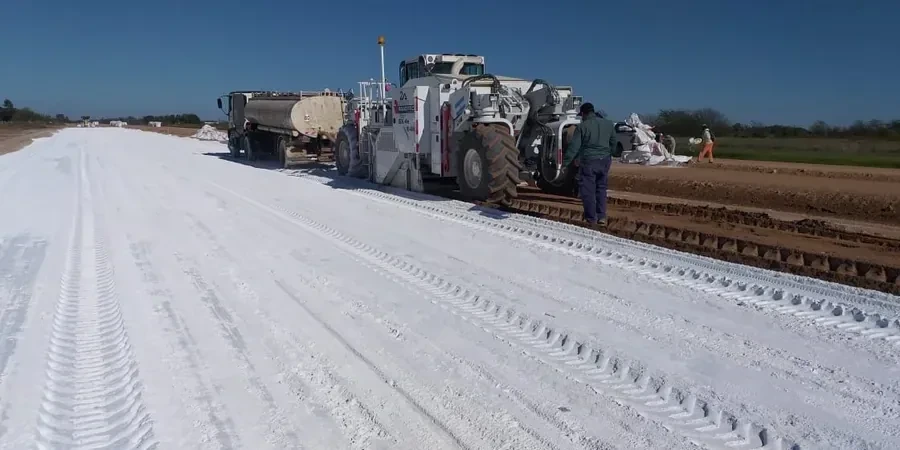
Lime reduced the plasticity index from 42 to 18 in a single treatment pass on a Cincinnati highway project, cutting subgrade failure risk by over 60%.
Technical details of the service in Cincinnati
Procedure video
Critical ground factors in Cincinnati
We mobilize a pugmill mixer and a 10-ton silo truck to job sites across Cincinnati. The pugmill blends dry stabilizer with the soil at a controlled rate, then a water truck adds moisture to reach optimum compaction. If the mix is too dry, the reaction stalls and strength never develops. Too wet and the soil becomes unstable under rollers. We monitor moisture content in real time using a nuclear density gauge. In one project near the Cincinnati Zoo, the clay was so plastic that the lime took 48 hours to start reacting. We had to adjust the water schedule and extend the mellowing period. That kind of site-specific adjustment only comes from experience with local soils.
This service complements our laboratory testing work for a complete project analysis.
Our services
We offer four specialized stabilization services tailored to Cincinnati's soil conditions. Each service includes laboratory mix design, field application supervision, and quality control testing.
Lime Stabilization for Expansive Clays
Treatment of high-plasticity clays (PI > 35) using quicklime or hydrated lime. Reduces swell potential and improves workability. Includes mellowing period monitoring and compaction control.
Cement Stabilization for Low-Plasticity Soils
Portland cement mixing for silts, sands, and lean clays. Achieves rapid strength gain (24-48 hours) and reduces dust generation. Suitable for pavement subgrades and shallow foundations.
Combined Lime-Cement Treatment
Two-stage process: lime pretreatment to reduce plasticity, then cement addition for structural strength. Used when soils have intermediate plasticity (PI 20-35) and require both workability and load-bearing capacity.
Quality Control Testing Program
Unconfined compression tests at 7 and 28 days, moisture-density curves (ASTM D698), field density checks (ASTM D6938), and plasticity verification after treatment. Reports include strength gain trends and acceptance criteria per project specifications.
Common questions
How does lime stabilization differ from cement stabilization for Cincinnati soils?
Lime reacts chemically with clay minerals to reduce plasticity and shrink-swell potential. Cement hydrates to form a rigid matrix that increases compressive strength. For Cincinnati's fat clays (PI above 35), lime is preferred first to control plasticity. Cement works better for silts and sandy soils where rapid strength gain is needed.
What is the typical cost range for lime and cement stabilization in Cincinnati?
The typical cost range is between US$940 and US$2,870 per project, depending on treatment depth, soil volume, stabilizer dosage, and haul distance. We provide a detailed quote after reviewing the soil classification report and site access conditions.
How long does the stabilization process take before the soil can support construction loads?
Lime-treated soils usually require a 3-7 day mellowing period before compaction, then 7-14 days to reach 70% of design strength. Cement-treated soils can support light traffic within 24-48 hours. We always verify strength with unconfined compression tests before allowing full construction loads.