A 10-story residential tower near the Ohio River in Cincinnati required significant Improvement before foundation work could begin. The site, underlain by soft alluvial clays and silts, exhibited high compressibility and low shear strength. Without intervention, post-construction settlements would exceed tolerable limits. The design team specified preloading with surcharge to accelerate primary consolidation and reduce long-term creep. This method involves placing a temporary load, typically 1.2 to 1.5 times the design load, over the building footprint. Settlement plates and piezometers are installed to monitor pore pressure dissipation and deformation rates. The surcharge remains until 90% or more of expected consolidation occurs, often within three to six months for the shallow clay layers. The approach avoids deep foundations and reduces overall project cost while meeting IBC 2021 and ASCE 7-22 requirements for differential settlement control.
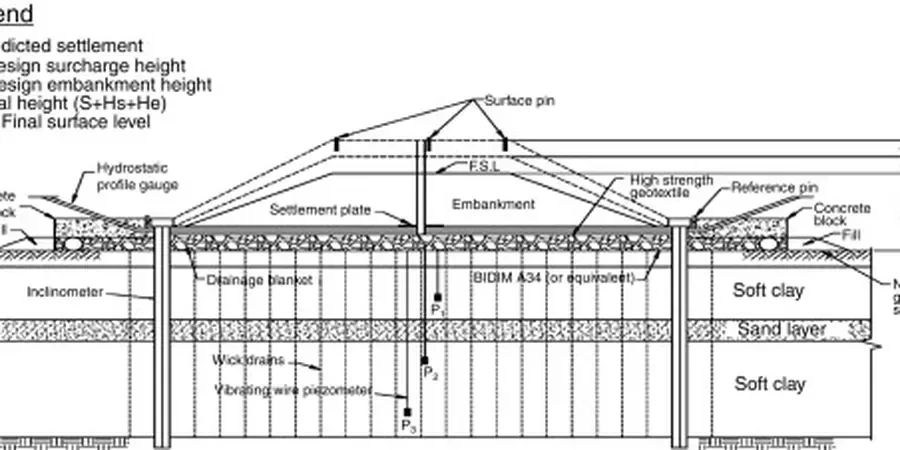
Preloading with surcharge reduces post-construction settlement by up to 70% in compressible soils when combined with proper instrumentation and staged removal.
Technical details of the service in Cincinnati
Procedure video
Critical ground factors in Cincinnati
Cincinnati's urban development along the Ohio River floodplain has created a legacy of soft ground conditions beneath older buildings. Many mid-century structures were built on spread footings without Improvement, leading to differential settlements of 50 to 150 mm over decades. Retrofits and new construction in these areas must address the risk of ongoing consolidation and creep. A preloading with surcharge design that includes careful stage loading prevents shear failure of the subgrade and ensures that settlement occurs before the permanent structure is built. The method also reduces the risk of damage to adjacent utilities and pavements, which is critical in dense neighborhoods like Over-the-Rhine and the Central Business District.
This service complements our laboratory testing work for a complete project analysis.
Our services
We provide complete preloading with surcharge design services in Cincinnati, from initial site investigation to final monitoring reports. Our team integrates field data with numerical modeling to optimize fill heights and durations.
Consolidation Analysis and Surcharge Design
Laboratory consolidation tests (oedometer) on undisturbed samples to determine preconsolidation pressure, compression index, and coefficient of consolidation. We compute required surcharge height and duration using Terzaghi's one-dimensional theory.
Instrumentation and Monitoring
Installation of settlement plates, vibrating-wire piezometers, and inclinometers with automated data acquisition. Weekly reports include pore pressure trends, settlement rates, and comparison to predicted behavior.
Surcharge Removal and Post-Construction Assessment
Staged removal of fill with continuous monitoring of rebound. Final elevation survey confirms that residual settlement is within 25 mm over a 10-year design life. We issue a certificate of compliance for foundation release.
Common questions
How long does preloading with surcharge take in Cincinnati's clay soils?
For shallow clay deposits up to 6 meters deep, typical surcharge durations range from 3 to 6 months to reach 90% consolidation. Deeper deposits with vertical drains may require 6 to 9 months. The exact duration depends on the coefficient of consolidation (cv) measured in oedometer tests and the drainage path length.
What settlement criteria are used for preloading design in Cincinnati?
Most local projects target a maximum post-construction settlement of 25 mm over 10 years for buildings and 50 mm for pavements, in accordance with IBC 2021 Table 1804.1. Differential settlement is limited to 1/300 of the span between columns. Preloading surcharge is designed to achieve these limits before permanent loads are applied.
What factors affect the cost of preloading with surcharge in Cincinnati?
The total cost depends on the volume of fill required, duration of surcharge, instrumentation needs, and site access. A typical reference range for engineered design and monitoring is between US$760 and US$2,650 per project, though larger sites with deeper clays may be higher. Contact us for a site-specific quote.
Can preloading be combined with other Improvement methods?
Yes. When natural drainage is slow, we combine preloading with prefabricated vertical drains (PVDs) spaced 1.5 to 2.5 meters apart. This reduces consolidation time by up to 70%. For very soft organic layers, a temporary surcharge of geotextile-reinforced fill may be used to prevent bearing failure during construction.