Cincinnati sits on a landscape shaped by glacial boundaries and the Ohio River valley. The soils here are anything but uniform. Glacial till over shale and limestone is common on the hillsides, while soft alluvial deposits fill the floodplains. That contrast matters for retaining wall design. A wall that works in Hyde Park might fail in the basin. We see this mismatch often. The key is matching the wall type to the specific soil profile at depth. Before committing to a design, we always recommend a capacidad de carga test to verify bearing strength at the proposed base. That single number changes everything.
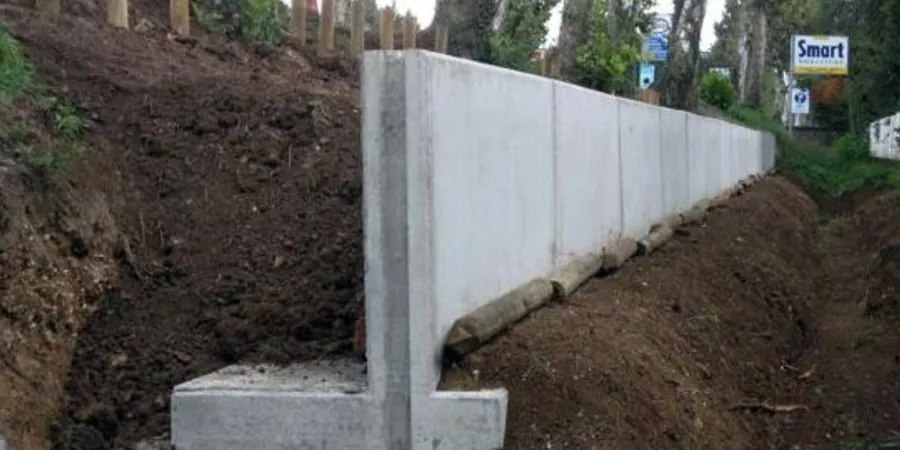
Glacial till over weathered shale at 8 feet changed the design from cantilever to soil-nailed system on a Mount Adams slope.
Technical details of the service in Cincinnati
Critical ground factors in Cincinnati
The difference between a wall on Mount Lookout and one in the Ohio River floodplain is night and day. Uphill, you fight boulders and stiff clay. Downhill, you deal with soft silt and a high water table. In both places, the worst failure mode is a slow rotation caused by undrained clay creep. We have seen walls tilt 6 inches over a decade because nobody checked the Atterberg limits. For Cincinnati retaining wall design, the single biggest risk is underestimating the lateral pressure from wet backfill behind the wall. That mistake can turn a $30,000 wall into a $100,000 repair.
This service complements our laboratory testing work for a complete project analysis.
Our services
We provide four core services for retaining wall design in Cincinnati, from soil investigation to final construction support.
Soil investigation and borings
We drill at least three borings per wall alignment. SPT at 5-foot intervals. Lab testing for shear strength, plasticity, and compaction. All data goes into the design model.
Slope stability analysis
For hillside walls, we run Bishop and Spencer analyses. We check for circular and non-circular failure surfaces. If the factor of safety is below 1.3, we redesign the wall or add soil nails.
Structural wall design
We design cantilever, gravity, and segmental retaining walls. Reinforcement follows ACI 318. Drainage systems are integrated to prevent hydrostatic pressure buildup behind the wall.
Construction monitoring
We visit the site during excavation and backfilling. We verify that the bearing soil matches our assumptions. We test compaction of the backfill in real time. Any deviation gets flagged immediately.
Common questions
How much does a geotechnical study for a retaining wall in Cincinnati cost?
For a typical residential wall, a study including three borings, lab testing, and a design report runs between US$1,210 and US$4,560. The range depends on access, depth, and required testing volume.
What soil conditions in Cincinnati most affect retaining wall design?
The biggest factor is the glacial till over shale interface. If the wall base sits on till but the excavation exposes weathered shale, drainage changes completely. Alluvial silts near the river also create seepage problems. We always check for perched water tables.
How long does the design process take from site visit to final plans?
Typically three to four weeks. The first week covers drilling and lab testing. The second week is analysis and modeling. The third week produces the drawings and specifications. We can compress this to two weeks for urgent projects.