A hillside development in Mount Adams revealed the challenge Cincinnati's topography poses. Steep slopes undercut by the Ohio River create active erosion zones that threaten foundations and retaining walls. We assess these sites using the Revised Universal Soil Loss Equation (RUSLE2) and direct field measurements. For projects near riverbanks, we often combine erosion analysis with geotextile design to stabilize the surface before any grading begins. Our lab determines soil erodibility factor (K) from texture, organic matter, and permeability data collected on site.
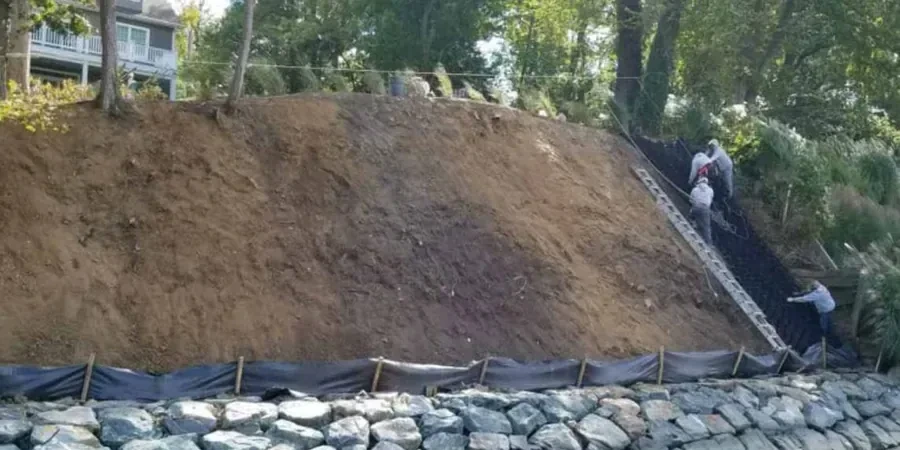
Cincinnati's loess-derived silt soils lose up to 12 tons per acre annually on unprotected 15% slopes.
Technical details of the service in Cincinnati
Critical ground factors in Cincinnati
Cincinnati's freeze-thaw cycles loosen the surface, making spring rains especially dangerous. We have seen retaining walls fail because the designer assumed a flat site when the actual slope exceeded 2:1. Unchecked erosion undermines pavement edges, exposes utility lines, and fills storm drains with sediment. The city's combined sewer system can overflow when sediment blocks inlets. Our erosion analysis identifies these failure zones early, allowing engineers to specify stabilization methods before construction. Ignoring the K-factor for local soils often leads to under-designed sediment basins that violate EPA NPDES permits.
This service complements our laboratory testing work for a complete project analysis.
Our services
We offer three specialized erosion analysis services tailored to Cincinnati's geology and regulatory requirements.
RUSLE2 Modeling & Erosion Rate Mapping
High-resolution erosion prediction using site-specific R, K, LS, C, and P factors. Output includes isopach maps of soil loss for pre- and post-construction scenarios.
Sediment Basin Design & Sizing
Hydrologic analysis to determine required basin volume per Ohio EPA standards. We model 2-year, 24-hour storms and provide detention time calculations.
Erosion Pin Monitoring & Field Validation
Installation of steel pins along slope transects with quarterly measurements over 1–3 years. Data validates model predictions and tracks BMP effectiveness.
Common questions
What is the difference between sheet erosion and rill erosion?
Sheet erosion removes a uniform layer of topsoil by overland flow, often invisible until roots become exposed. Rill erosion forms small channels that concentrate flow, typically less than 30 cm deep. We distinguish both during field surveys and model them separately in RUSLE2.
How much does a soil erosion analysis cost in Cincinnati?
Typical costs range between US$770 and US$2,400 depending on site area, slope complexity, and whether field monitoring is included. A basic desktop analysis using existing soil surveys is at the lower end; full field data collection and RUSLE2 modeling falls at the upper end.
Do I need an erosion analysis for a residential lot?
Ohio EPA requires a SWPPP for any construction disturbing one acre or more. For smaller lots, banks and insurance companies often request erosion analysis before funding hillside developments. We recommend it if your lot has slopes steeper than 10% or is within 200 ft of a stream.
What permits does the erosion analysis support?
The analysis directly supports Ohio EPA NPDES Construction General Permit applications, local stormwater management approvals, and sediment control plans. It also satisfies the erosion component of LEED site development credits.